Taking a closer look at Microscope
You find yourself in front of a door made of heavy, dark wood, and inscribed with a calendar of moon phases and constellations. A scrap of paper sticks out from the bottom of it, yellowed with age. It begins:
Microscope is a world building TTRPG published by Lame Mage Productions. Published quite a while ago, too, back in 2011 (15 years ago!) making this the oldest game I've talked about so far. It's a staple of the indie TTRPG scene, one of the games that you've probably heard about even if you haven't played it.
In Microscope, you create a timeline of events at varying levels of scope and scale. You can zoom out to define whole periods of history, or zoom in to a specific moment. It's GM-less, with each player taking on the role of the "Lens" throughout play, dictating the "Focus" of that round - the thing (event, person, theme, institution) that every contribution will touch on. Players then take turns adding either a period (a swathe of time), an event (a specific thing that occurs within a period), or a scene (a single moment within an event) to the timeline. The round ends when every player has gone once (except the Lens, who goes twice) and the role of Lens passes to the next person.
Generally I feel like my thoughts on Microscope can be summed up thusly:
Microscope is not the most exciting game of all time, but it is a well made game that does what it sets out to do, and it is a foundational building block that many games that I like have been built on. Such is the case with many games from the early 2010s, but Microscope in particular just doesn't have enough for me. It doesn't have The Sauce™.
...
Anyways, there's a rule in Microscope that I haven't stopped thinking about since I played it:
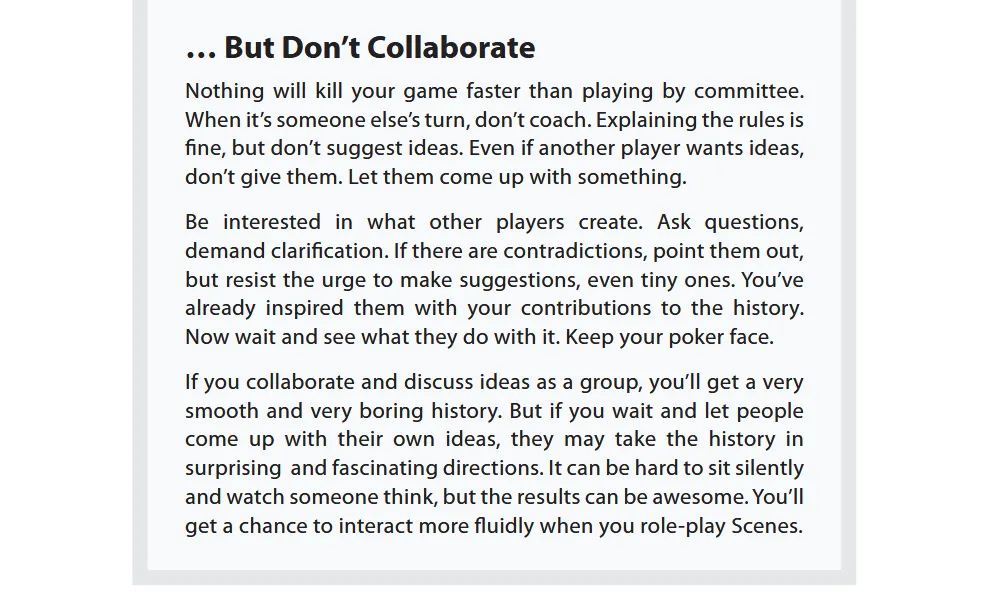
Don't collaborate. Don't collaborate? In my collaborative tabletop roleplaying game?
(It's more likely than you think.)
I played Microscope with a group of friends that I have played a looooot of TTRPGs with. When we came across this rule, we were baffled. Why is this here? Why wouldn't we collaborate? That's kinda The Thing we're here to do!
My first thought was that it's there to assist less confident players. To prevent them from being talked over and give them space and time to create their own contributions.
Which makes sense! Microscope doesn't really have defined borders, it's much more focused on telling you what you can do vs what you can't do. Add the lack of a GM or solid mediator and it's easy for some players to become the loudest voices at the table and step on others' toes.
My second thought was that it's there to prevent turns from going on too long. When you've got everyone jumping in with ideas it definitely runs the risk of stretching your game time as each idea needs to be considered or dismissed, and since Microscope is meant to be able to run in one session it needs to keep things tight.
But that's neither of these are actually what the rule says it's there for:
If you collaborate and discuss ideas as a group, you’ll get a very smooth and very boring history. But if you wait and let people come up with their own ideas, they may take the history in surprising and fascinating directions.
The key words here are boring, surprising, and fascinating — Microscope wants you to do weird shit; it wants you to stop being precious with your toys. There's a whole section about how OK it is to destroy things that others have established:
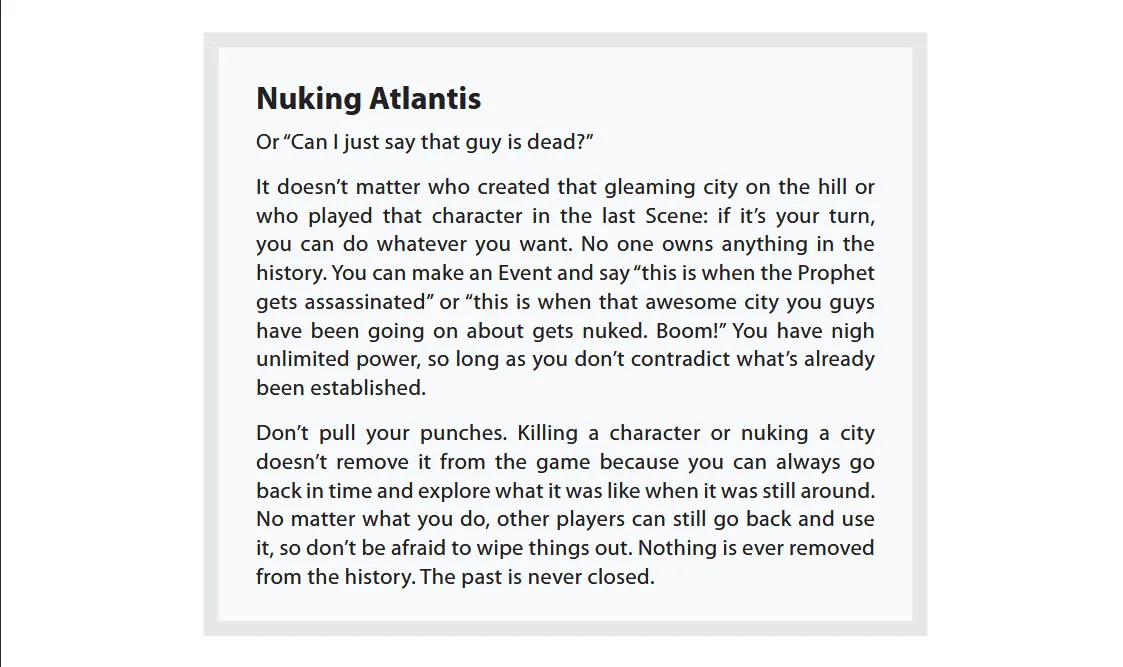
(The answer is very.)
So while I think this rule does give everyone at the table a chance to speak, and does keep the game going, the main purpose of it is to keep your game weird and encourage people to create unique ideas that may not mesh with what other people at the table are thinking.
However, I don't know if I agree with the assumption that working collaboratively will create less interesting ideas. Plus, the secret is that Microscope is still a collaborative game, even though it explicitly discourages collaboration. You're still creating the timeline together, and the things that you create will influence what the other players create and vice versa. The game actually points this out in the first part of the aside that I neglected to show you earlier:
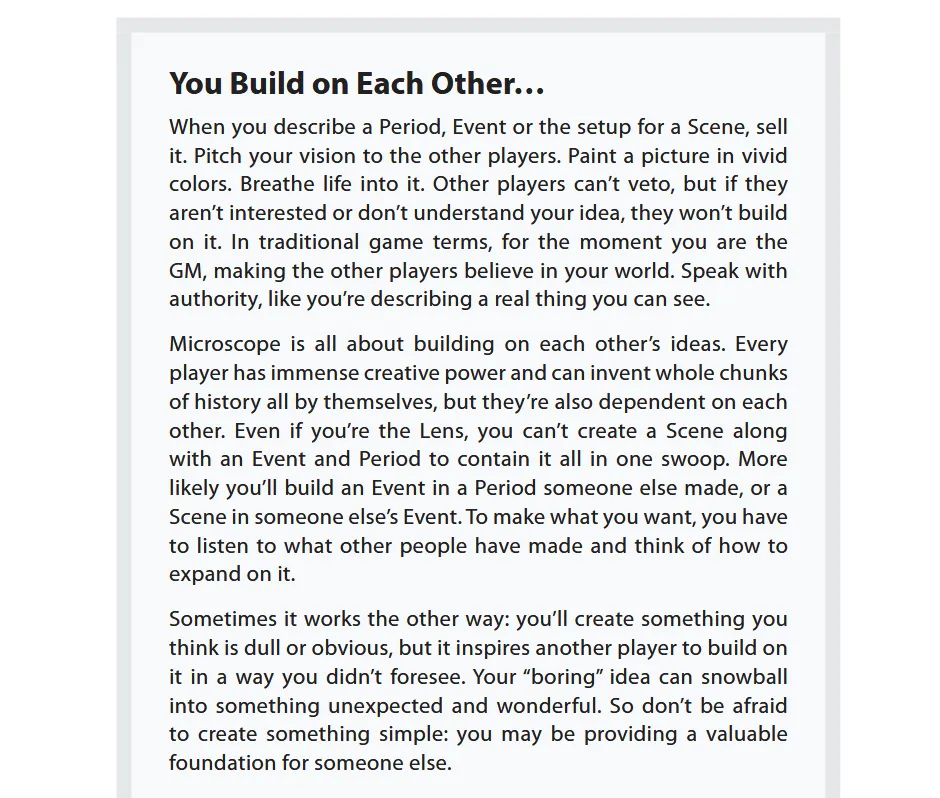
Which I think is part of why this rule hit me as really odd at first. It feels contradictory to have a header saying "Don't Collaborate" after explaining how you're going to collaborate with each other during play, and even though the section goes on to explain that you're not meant to collaborate with each other in specific ways during specific parts of the game my main takeaway from my initial read-through was that we weren't meant to collaborate at all — which then lead to my initial reaction of "but that's literally what I'm here to do!"
I did, eventually, get it, but only after we'd finished our game and I started writing this post. Which I think is really unfortunate, especially since I now really like the rule where before I wasn't taking it seriously at all.
Part of what helped me understand it was reading through the afterword in Microscope, a small section at the back of the rulebook where Ben literally talks about "How Microscope Works," including a section about this specific rule!
In it, Ben goes over why this rule exists, and actually mainly talks about the first point I came up with: that it keeps more dominant players from overshadowing any wallflowers at the table. But the part that got me is this paragraph:
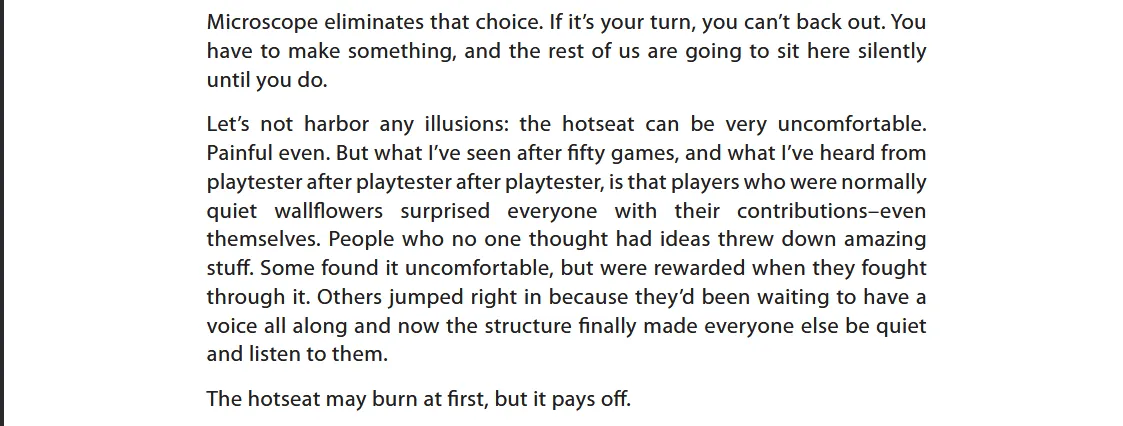
And, yeah, that discomfort is definitely something I experienced and have experienced before while playing other games. Sitting with everyone's eyes on you and struggling to come up with something interesting is not fun, and there's always the fear that you'll come up with something that's bad.
Ben addresses this too, though:
This makes sense with the way Microscope works, though it's perhaps a bit contradicted by earlier parts of the book that talk about how you need to pitch the other players on what you create so they'll be interested in exploring it. It's impossible to fully remove that pressure to create something cool; we all want to impress the people we play with. Still, the more I thought about it, the more I ended up liking this rule.
The main reason is that it challenges a feeling that I have, which is that I come up with more interesting ideas when I'm bouncing them off of other people.
And I think that's a worthwhile thing to have challenged. I'm a creative guy! I have ideas, I make stuff! Sometimes I do it all by myself! This isn't something that changes when I'm making stuff with other people, but I do tend to defer to the people I'm with in those situations. I think most people do — or at least feel like they do! Especially the kinds of folk who play TTRPGs.
So, while I still don't fully agree with the idea that collaborating with others makes your game (or project, or anything else you do) less interesting, I do think that this rule forces players to exercise their own creative confidence. Which is good! Plus it adds something really interesting to Microscope.
It gives it The Sauce™.
I did, by the way, literally change my opinion on Microscope and this rule as I was writing this post, which was originally going to be a piece about how weird and bad this rule is. But it turns out that it's good, and that Microscope is good, almost like there's a reason why its such a long standing staple of the indie scene. I would love to play it again while taking this rule more seriously and see if my opinion changes even more.
It also makes me wonder what other games would benefit from this sort of non-collaborative gameplay. Could this be taken even further? Could you create a game that's almost entirely parallel play? A game where the players aren't allowed to talk to each other at all? What would happen if you took a fully collaborative game and changed bits of it to be non-collaborative?
Imagine a game where everyone is wordlessly putting up index cards on a board. Zero communication allowed beyond what's written and what's read, the only connecting thread being the rules of the game — whatever those may be.
I bet this would create something really interesting!
Or maybe it wouldn't work at all, who knows.
If you know of other games that do this sort of thing, let me know by hitting me up on tumblr or bluesky, and if you have an idea for how to integrate this into a game or have your own thoughts on Microscope I'm very interested in hearing those as well.
Thanks for reading!
- N.A.
p.s. oooo i love to procrastinate oooo i love to slide posts in right under the wire of the end of the month
seriously though writing this post was really fun i love to find out im wrong about something. everyone should do this — if you find something that bothers you think about why!! maybe you are actually the one who is stupid. it can happen to anyone.
the most "ah fuck" moment of writing this is when i read the afterword in Microscope for the first time and gang. when i found the section about this rule i was like. ah. fuck. and then i went back and rewrote half the post.
moral of the story: read the whole rulebook before trying to critique it, and also everybody should put an explanation of why they did things the way they did in their game*. its such a cool and fantastic resource for future designers!
*or at least write a blog post about it :3
im currently running Under Hollow Hills and having an incredible time with it so that will probably be what i write about next and maybe this time! i will not post on the last day of the month. maybe.
see you then!